
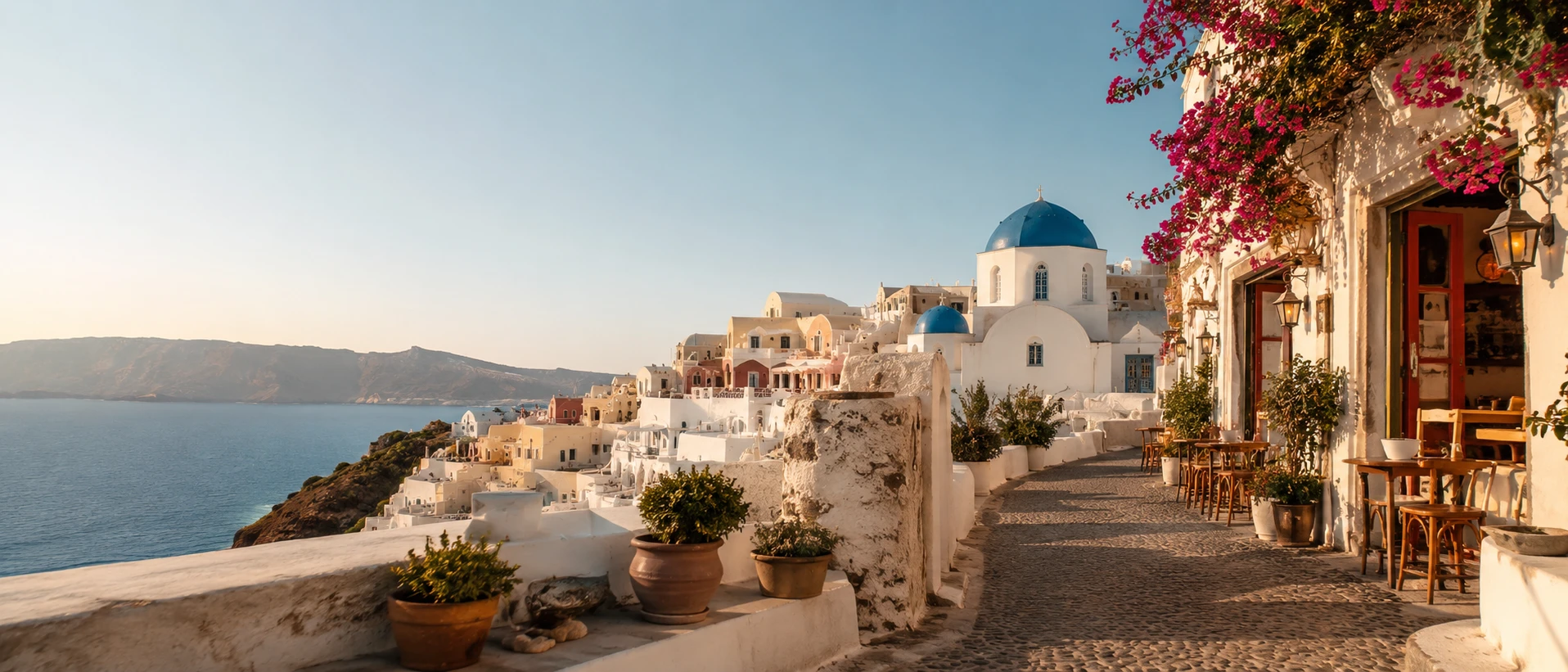
The Ultimate Europe Travel Guide for Canadian Travellers
Where to go, when to go, how long to stay and how to get around — France, Italy, Greece, Spain, Portugal, Switzerland, Central Europe and Scandinavia, matched to the way you actually want to travel.
Europe has a remarkable ability to make perfectly sensible travellers lose all sense of geography.
A couple begins planning ten days in Italy. Twenty minutes later, someone has added Paris because "we're already over there," Switzerland because "it's basically on the way," and possibly Greece because the photos looked nice.
Soon the itinerary resembles a diplomatic tour.
Europe encourages this behaviour because everything appears close together on a map. Countries sit side by side. High-speed trains cross borders. Low-cost flights make distant cities look suspiciously convenient.
The problem is that close together does not always mean easy to combine well.
A good European trip is not about collecting countries. It is about creating rhythm.
Paris deserves time to become more than the Eiffel Tower. Italy rewards travellers who stop treating every city as a checkpoint. Greek islands are considerably more enjoyable when you are not packing for a ferry every other morning. Switzerland becomes memorable when the train itself is part of the journey rather than simply transportation between hotels.
For Canadian travellers, the real questions are not just Where should we go?
They are:
How much is too much? Which places belong together? When should we travel? Where should we slow down? And when is a two-hour flight actually a six-hour travel day wearing a clever disguise?
This guide is designed to answer exactly that.
Where Should You Go in Europe?
There is no single "best" European destination.
That would be convenient, but Europe has spent several thousand years developing regional identities and is unlikely to simplify itself now.
The better question is:
What do you want the trip to feel like?
Do you want art and long lunches? Islands and beaches? Mountains and trains? Big-city energy? Wine country? Medieval streets? A hotel where breakfast lasts long enough to interfere with lunch?
Start there.
France
Paris, Bordeaux, Burgundy, Provence, the French Riviera & Normandy
France: For People Who Understand That Lunch Can Be an Event
Paris attracts most of the attention, which is understandable.
Few cities have marketed themselves as successfully.
But reducing France to Paris is like judging an entire restaurant from the bread basket.
Travel south and Provence changes the rhythm completely. Head toward Bordeaux or Burgundy and wine becomes part agriculture, part culture, part perfectly respectable reason to reorganize an afternoon. On the French Riviera, the Mediterranean changes the palette. Normandy turns toward cliffs, villages and very different chapters of French history.
France works particularly well because it can deliver several kinds of trip without crossing a border.
You can begin with museums and architecture in Paris, continue into vineyard country, slow down in Provence and finish beside the Mediterranean.
That is a considerable amount of personality for one passport stamp.
France Is Particularly Good For
- Art and museums
- Exceptional food and wine
- Historic cities
- Countryside
- Coastal escapes
- Luxury hotels and experiences
For a first European trip, Paris also combines naturally with London, Amsterdam, Belgium, Switzerland or Italy.
Why France Works So Well on a First Trip
France gives first-time visitors something reassuring: familiarity.
You already know some of the landmarks.
Then the country begins quietly contradicting whatever image you arrived with.
Paris is grand, but neighbourhood life can feel surprisingly intimate. Provence can be glamorous one afternoon and agricultural the next. The Riviera may evoke yachts and polished hotels, yet drive inland and villages begin appearing on hillsides as though nobody informed them about modern tourism.
France works best when you allow those contrasts to coexist.
Italy
Rome, Florence, Venice, Tuscany, Lake Como, the Amalfi Coast, Sicily, Puglia & Sardinia
Italy: The Country Most Likely to Punish an Overambitious Itinerary
Italy creates a specific planning problem.
Nearly everything looks essential.
Rome? Obviously.
Florence? You cannot skip Florence.
Venice? Surely not.
Then somebody mentions Lake Como.
Then Tuscany.
Then the Amalfi Coast.
By the time Sicily enters the conversation, you are no longer planning a holiday. You are conducting a national survey.
Italy is one of those places where trying to see everything usually means enjoying less of it.
Rome: History Without Much Interest in Staying in the Past
Rome does not present history politely.
It puts ancient ruins beside traffic, churches beside cafés and archaeological sites beneath buildings where people still need to buy groceries.
The city is not arranged chronologically.
That is part of its appeal.
You can spend the morning in imperial Rome, the afternoon in a Renaissance church and the evening having pasta on a street that has witnessed several centuries of other people also having dinner.
Florence: Where Ambition Became Architecture
Florence is the heart of Renaissance Italy, and it makes an excellent argument for what can happen when wealth, rivalry, politics and artistic ego all arrive in the same city at roughly the same time.
The result is extraordinary.
It is also compact enough that travellers often make the mistake of seeing too much too quickly.
Florence rewards walking.
It rewards looking up.
And it rewards the occasional decision to abandon the schedule in favour of an aperitivo.
Venice: A City That Should Not Really Be There
Venice remains one of Europe's great acts of collective engineering confidence.
A city was built across a lagoon on foundations driven into mud.
Humanity then looked at this logistical problem and decided it needed marble palaces.
Venice feels unlike anywhere else in Europe because it is unlike anywhere else in Europe.
Stay long enough to experience it beyond the busiest daytime hours.
The city changes once the day-trippers begin leaving.
The Classic First Italy Itinerary
Rome → Florence → Venice
This remains popular because it works.
The cities are culturally distinct, connected logically and substantial enough to justify several nights each.
Travellers with more time can add Lake Como, Tuscany or the Amalfi Coast.
Those returning to Italy should seriously consider doing the opposite of what many first-time visitors do:
Choose one region and stay longer.
Italy becomes much more interesting when the itinerary stops shouting.
Greece
Athens, Santorini, Mykonos, Crete, Paros, Naxos, Milos & Corfu
Greece: Ancient History Followed by a Very Long Lunch
Greece has spent several thousand years perfecting contrast.
Athens offers some of the most recognizable remains of the ancient world.
A short flight or ferry later, you are on an island wondering whether lunch should perhaps continue until sunset.
This is not inconsistency.
It is excellent trip design.
Athens First, Islands Second
Spend a few days in Athens before continuing into the islands.
The capital gives the trip historical grounding and makes the transition to island life feel even more dramatic.
Then choose carefully.
Santorini
Santorini is known for dramatic caldera views and romantic stays.
It is one of those destinations where the geography itself appears to have been designed with sunset photography in mind.
Mykonos
Mykonos brings stylish beaches, restaurants and nightlife.
It suits travellers who want the island experience with more energy after dark.
Crete
Crete is different.
It is large enough to feel like a destination in its own right, with beaches, villages, history and exceptional food.
Travellers who want more depth and less island-hopping should give it serious consideration.
Beyond the Famous Names
For travellers looking beyond Santorini and Mykonos, Greece has countless alternatives, including:
- Paros
- Naxos
- Milos
- Corfu
The Biggest Greece Mistake
Trying to visit too many islands.
Ferries look romantic in photographs.
Less romantic is repacking luggage every second morning, checking out, waiting at a port, boarding, arriving, transferring, checking in again and then realizing you are leaving 36 hours later.
Three islands are not automatically better than two.
Sometimes they are simply more luggage.
Spain
Barcelona, Madrid, Seville, Granada, Córdoba, Mallorca & the Canary Islands
Spain: Several Countries Pretending to Be One
Spain can feel like multiple destinations contained inside one border.
Barcelona has one rhythm.
Madrid has another.
Andalusia introduces an entirely different visual and cultural vocabulary.
Then the islands change the conversation again.
Spain works particularly well for travellers who want variety without necessarily adding another country.
Barcelona: Architecture With Opinions
Barcelona combines Mediterranean life with architecture that refuses to be background scenery.
The city's streets, markets and coastline all matter, but its buildings frequently steal the argument.
This is particularly true where Gaudí is concerned.
Barcelona is one of the few places where you can look at a building and reasonably wonder whether the architect briefly decided that straight lines lacked imagination.
Madrid: The Capital That Stays Out Late
Madrid delivers world-class museums, nightlife and food.
It feels more urban and less coastal than Barcelona, with a stronger sense of grand boulevards, neighbourhood bars and late evenings.
This is not a city that seems especially interested in going to bed early.
Visitors may need to adjust accordingly.
Andalusia: History Gets More Complicated
In Seville, Granada and Córdoba, Spain's past becomes much more layered.
Architecture, religion and politics overlap visibly, particularly in the legacy of Muslim rule in the Iberian Peninsula.
This is where Spain stops feeling like a single story.
And that is precisely why the region is so rewarding.
Spain Is Particularly Good For
- Culture
- Beaches
- Nightlife
- Gastronomy
- Architecture
- Warm weather
Then there are Mallorca and the Canary Islands, proving that Spain's relationship with the sea extends considerably beyond the mainland.
Portugal
Lisbon, Sintra, Porto, the Douro Valley & the Algarve
Portugal: Europe at a More Civilized Speed
Portugal works especially well for travellers who want a rich European trip without constructing an overly complicated route.
The geography helps.
So does the pace.
Begin in Lisbon, where hills, viewpoints and historic neighbourhoods turn even a short walk into either an atmospheric experience or an unexpected cardiovascular event.
Then add Sintra, travel north to Porto, continue into the Douro Valley, and head south to the Algarve if beaches and relaxation belong in the plan.
The itinerary makes sense.
Which is surprisingly refreshing.
Lisbon: Beautiful, Hilly and Completely Uninterested in Your Footwear
Lisbon rewards wandering.
It also rewards proper shoes.
Its slopes are photogenic partly because nobody designed them with rolling luggage in mind.
The city works as both a cultural stop and a launching point for nearby experiences such as Sintra.
Porto & the Douro Valley
Porto has a different rhythm from Lisbon.
The Douro River shapes the city visually, while wine culture ties Porto naturally to the valley inland.
Continue east and the landscape changes into terraces and vineyards.
This is the sort of transfer where the journey itself deserves attention.
Algarve: When the Itinerary Needs to Exhale
Continue south for beaches and a slower finish.
The Algarve gives travellers a useful change of pace after city touring.
Portugal also combines naturally with Spain for travellers who want to experience the Iberian Peninsula in a single journey.
Switzerland
Lucerne, Interlaken, Zermatt, Grindelwald, Montreux & Zurich
Switzerland: The Train Journey May Be Better Than the Arrival
Switzerland is less about collecting monuments.
It is more about watching the landscape perform.
Mountains rise beside lakes. Villages appear beneath peaks. Rail lines thread through scenery that seems to have been designed by a tourism board with excessive resources.
The extraordinary thing is that much of it is simply the commute.
Come for the Landscape
Popular bases include:
- Lucerne
- Interlaken
- Zermatt
- Grindelwald
- Montreux
- Zurich
Each opens onto a different version of Switzerland, but the principle remains the same:
Do not plan the country only around towns.
Plan around mountain railways, lakes, villages and scenic train journeys.
A rail day in Switzerland is not necessarily a lost sightseeing day.
It may be the sightseeing.
What Switzerland Combines Well With
Switzerland fits particularly well with:
- Northern Italy
- France
- Germany
- Austria
This makes it useful in a multi-country itinerary, especially when the route follows geography rather than wishful thinking.
Austria, Germany & Central Europe
Vienna, Prague, Budapest, Berlin & Bavaria
Central Europe: Where Empires Left Excellent Architecture Behind
Travellers interested in history, classical architecture and traditional European cities should look toward Central Europe.
The region is particularly good at giving you three very different cities without requiring enormous travel days.
Vienna: Empire With Cake
Vienna offers imperial architecture, cafés and classical music.
The Habsburg legacy appears almost everywhere, which is understandable given that the family once seemed determined to be involved in most of European history.
Fortunately, Vienna also developed café culture.
This means serious historical sightseeing can be interrupted by coffee and cake with a perfectly respectable cultural justification.
Prague: The City Everyone Photographs
Prague has one of Europe's most beautiful historic centres.
Its towers, bridges and old streets attract enormous attention, and deservedly so.
The key is timing.
Early mornings and evenings can reveal a very different Prague from the middle of the day, when parts of the centre become much busier.
Budapest: Two Cities, One River
Budapest is divided by the Danube, with Buda and Pest offering different topography and atmosphere.
The city combines grand architecture, thermal baths and a vibrant dining scene.
Few European capitals offer quite the same combination of monumental scale and the possibility of spending part of the afternoon sitting in hot water.
An admirable urban planning achievement.
Germany: More Than One Personality
Germany ranges from Berlin's contemporary energy to Bavaria's castles and alpine scenery.
That contrast makes it especially useful for travellers who want urban culture combined with countryside.
One of the Best Central Europe Routes
Prague → Vienna → Budapest
This remains one of Europe's strongest three-city itineraries.
The cities connect well.
The travel days are manageable.
And each destination feels genuinely different.
That last point matters.
The best multi-city trips do not simply move you to a new hotel.
They change the atmosphere.
Scandinavia
Copenhagen, Stockholm, Oslo, Helsinki & the Norwegian Fjords
Scandinavia: Europe With the Volume Turned Down
Northern Europe delivers a very different experience from the Mediterranean.
Copenhagen, Stockholm, Oslo and Helsinki combine modern design with historic neighbourhoods and strong culinary scenes.
Then leave the capitals and nature begins taking over.
Norwegian fjords. Remote coastlines. Mountains. Long summer evenings. And, during the right season and under the right conditions, opportunities to experience the northern lights.
Scandinavia suits travellers who want Europe without necessarily wanting the Europe of piazzas, cathedrals and Mediterranean beaches.
The light changes.
The food changes.
The pace changes.
So, generally, does the budget.
When Should Canadians Visit Europe?
Europe works year-round.
It just does not behave the same way year-round.
Spring: April to May
Spring is one of the most attractive periods for European travel.
Temperatures begin to rise, cities come back to life and many destinations remain less crowded than during peak summer.
It is particularly appealing for:
- Italy
- France
- Spain
- Portugal
- Greece
- Central Europe
Spring also suits travellers who like sightseeing without feeling they are being gently roasted by the afternoon sun.
Summer: June to August
Summer brings:
- The longest days
- The warmest temperatures
- The busiest travel period across much of Europe
It is ideal for:
- Greek islands
- Mediterranean beaches
- Croatia
- Southern Italy
- European cruises
- Alpine hiking
- Scandinavia
The trade-off is obvious.
Everyone else also likes good weather.
July and August can become extremely busy in famous destinations, so reserve important hotels, rail journeys, attractions and experiences well in advance.
Do not arrive in peak summer and act betrayed by the existence of other tourists.
You are, regrettably, one of them.
Autumn: September to October
For many travellers, September is one of Europe's best months.
The Mediterranean often remains warm, peak summer crowds begin to ease and major cities become more comfortable for sightseeing.
Particularly attractive destinations include:
- Italy
- Greece
- Portugal
- Spain
- France
October can also work beautifully for trips focused on food, wine and countryside.
There is something highly civilized about visiting a wine region during harvest season while other travellers are already debating winter coats.
Winter: November to March
Winter changes the character of Europe completely.
December brings Christmas markets across cities such as:
- Vienna
- Prague
- Munich
- Strasbourg
- Budapest
The Alps move into ski season.
Meanwhile major cities such as Paris, Rome and Madrid can feel dramatically different outside the summer rush.
Winter works particularly well for travellers who do not view Europe as merely a beach-delivery system.
How Long Should You Spend in Europe?
One of the most common European planning mistakes is assuming geographical closeness eliminates travel time.
It does not.
A country may be one border away and still consume most of a day to reach properly.
7 Days
Focus on one country or two nearby cities.
Good examples:
- Paris + London
- Rome + Florence
- Lisbon + Porto
- Athens + one Greek island
Seven days disappears quickly.
Treat it with respect.
10 Days
Ten days opens up several strong combinations:
- Rome → Florence → Venice
- Paris → Switzerland
- Madrid → Seville → Barcelona
- Prague → Vienna → Budapest
This is enough time to create movement without making the entire holiday about departures.
14 Days
Two weeks gives you room for a genuine multi-country itinerary without constantly packing and unpacking.
Examples: London → Paris → Switzerland → Italy, or Barcelona → French Riviera → Florence → Rome
Two weeks is where Europe begins to feel less like a sequence of city breaks and more like a journey.
Three Weeks or More
Longer trips should not automatically mean more countries.
That is the temptation.
Instead, use the extra time to travel differently.
Add countryside.
Spend several nights on an island.
Stay in a smaller town.
Rent a villa.
Take the slower train.
Europe becomes significantly more interesting once the itinerary moves beyond capitals and famous landmarks.
Train or Plane? How to Move Around Europe Without Losing Entire Days
One of Europe's greatest advantages is its transport network.
One of its greatest planning traps is using the wrong form of transportation simply because it looks faster on paper.
Take the Train When
Cities are relatively close and centrally located.
Routes such as:
- Paris–London
- Rome–Florence
- Florence–Venice
- Amsterdam–Paris
- Vienna–Budapest
can make rail travel particularly convenient.
Train stations are often located in or near city centres.
That means you avoid the airport journey, airport check-in, security and the strange airport phenomenon in which buying a sandwich somehow costs the equivalent of a respectable lunch.
Fly When
Distances become significantly longer.
Flying often makes more sense for routes such as:
- Paris → Athens
- London → Rome
- Portugal → Greece
- Mainland destinations → many islands
But compare door-to-door time, not flight time.
A two-hour flight can consume much of the day after: checkout + airport transfer + security + waiting + flight + baggage + arrival transfer + check-in.
The aircraft may only be airborne for two hours.
You are not.
Consider a Private Transfer or Driver When
The journey itself is worth experiencing.
This can be especially valuable in:
- Tuscany
- Provence
- The Amalfi Coast
- Rural Portugal
Smaller towns, vineyard areas and countryside hotels often do not fit neatly into rail schedules.
A driver can turn transportation into part of the trip.
You also avoid spending twenty minutes interpreting a rural bus timetable while standing beside several suitcases.
Europe Travel Requirements for Canadians
Canadian citizens can currently travel visa-free to countries in the Schengen Area for short stays of up to 90 days within any 180-day period.
For many Schengen destinations, a regular Canadian passport must remain valid for at least three months beyond the date you expect to leave the Schengen Area.
Travellers should always verify the rules for their specific destinations before departure.
Europe has also introduced its digital Entry/Exit System (EES) for non-EU nationals travelling for short stays.
Canadian travellers do not need to submit an EES application before travel; registration occurs as part of the border process.
What About ETIAS?
As of August 2026, ETIAS — the European Travel Information and Authorisation System — is not yet operating.
The European Union currently expects ETIAS to begin in the last quarter of 2026 and says travellers do not need to take action until the system launches.
Once implemented, it will become a travel authorisation requirement for eligible visa-exempt travellers visiting participating European countries.
Entry requirements can change.
Check again before departure.
Airports are not the ideal environment in which to discover that a regulation changed three weeks ago.
How Much Should You Budget for Europe?
There is no meaningful single "average" price for a European vacation.
A week in Switzerland during peak summer and a week in Portugal during shoulder season may technically occur on the same continent.
Financially, they may feel only loosely related.
Your budget depends heavily on:
Destination — Switzerland and Scandinavia generally require a different budget from many parts of Portugal, Greece or Central Europe.
Season — July and August can command premium pricing in major tourist destinations.
Hotel Standard — location matters as much as star rating. A slightly simpler hotel in the right neighbourhood can be more useful than a more elaborate property requiring a long commute.
Transportation — frequent flights, private transfers and premium rail travel can change the cost quickly.
Experiences — private touring, restaurant reservations, cruises and special-access experiences can become a significant part of the total trip.
Instead of asking:
"How cheaply can we see Europe?"
Ask:
"What matters most to us — and where is it worth spending more?"
That question tends to produce a much better trip.
Spend on the room with the view if the view matters.
Spend on a private guide where history needs explaining.
Spend on the transfer if it saves half a day.
Save where you genuinely will not notice the difference.
Travel budgets work better when they follow priorities rather than pride.
First Trip to Europe? Avoid These Mistakes
Trying to Visit Too Many Countries
Five countries in seven days may look impressive in an itinerary.
It looks less impressive from inside the fourth train station.
In practice, much of the holiday becomes:
Check out. Move luggage. Wait. Travel. Find hotel. Check in. Repeat.
You have technically seen Europe.
Mostly through windows.
Staying Too Far Outside the City
A cheaper hotel can become false economy when you spend substantial time travelling back and forth every day.
Location often matters more than an additional hotel star.
A beautiful hotel that requires 45 minutes of transport every morning is not necessarily convenient.
It is just beautiful somewhere else.
Planning Every Hour
Europe is particularly good at unscheduled interruptions.
A café you did not notice online. A small square. A market. A long lunch. A street that looks more interesting than the attraction you were walking toward.
Leave room.
A perfectly optimized holiday can become strangely joyless if every cappuccino is a scheduling problem.
Ignoring Travel Time
Again: a two-hour flight is not a two-hour travel day.
Neither is a three-hour train if the station is far away, you have luggage and your hotel room will not be ready until late afternoon.
Plan realistically.
Treating Europe Like One Destination
Greece is not France.
Portugal is not Switzerland.
Sicily does not feel like Venice.
Scandinavia does not behave like southern Spain.
This should be obvious.
And yet plenty of itineraries are built as though every country is merely a different backdrop for the same trip.
The most memorable European journeys embrace the differences.
What Kind of European Journey Is Right for You?
For First-Time Visitors
Consider:
- France + Italy
- London + Paris
- Italy on its own
- Spain + Portugal
These routes combine iconic destinations with relatively straightforward planning.
For Couples
Consider:
- Paris + French Riviera
- Tuscany + Amalfi Coast
- Santorini + Crete
- Portugal + Madeira
These combinations allow room for romantic hotels, slower meals and more atmosphere between major sights.
For Food & Wine
Look toward:
- Italy
- France
- Spain
- Portugal
Do not move constantly.
Stay longer in one region.
Visit vineyards, markets, restaurants and smaller towns.
Food improves considerably when dinner is not followed immediately by packing.
For Beaches
Explore:
- Greece
- Croatia
- Southern Italy
- Spain
- Portugal
- French Riviera
Each offers a different version of Mediterranean or Atlantic coastal travel.
For Mountains & Nature
Consider:
- Switzerland
- Austria
- Norway
- Slovenia
- Italian Dolomites
These destinations reward travellers who see transportation, hiking and scenery as part of the experience rather than time between attractions.
For History & Culture
Build around cities such as:
- Rome
- Athens
- Paris
- London
- Vienna
- Prague
- Berlin
- Istanbul
Then do something radical.
Stay long enough to understand at least one of them.
How to Build a Better Europe Itinerary
Start with how you want the journey to feel, not how many countries you want to claim afterward.
Choose one or two anchor destinations.
Then build outward using routes that make geographical sense.
Allow enough nights in each place to experience something beyond the headline attractions.
Mix major cities with somewhere slower:
A coastal town. An island. A countryside hotel. A mountain retreat. A vineyard region.
And resist the instinct to fill every blank space.
The blank space may become the afternoon you remember.
A beautifully planned ten-day trip through three places can be far more satisfying than racing through seven.
Seeing more is not the same as experiencing more.
Europe makes that lesson particularly expensive if you insist on learning it with luggage.
The Talaria View
There are thousands of perfectly valid ways to travel through Europe.
That is the problem.
And also the pleasure.
One traveller wants Paris, Florence and Rome.
Another wants vineyards, small hotels and long dinners.
Someone else wants Greek islands.
Another wants mountain trains, lake views and a suitcase containing entirely too many sweaters.
The best itinerary is not the one that travels the greatest distance.
It is the one in which each destination earns its place.
The route makes sense.
The pace feels human.
And somewhere in the middle of the trip, there is enough time to sit at a café without checking what comes next.
Because Europe does not really need help filling an itinerary.
It has spent centuries doing that.
The skill is knowing what to leave out.
Talaria Voyages creates personalized European journeys around the way you actually want to travel — from flights and carefully selected hotels to private touring, multi-country routes and complete vacation planning.
The continent can provide almost anything.
The art is choosing the right version of it.
Travel requirements, hotel offerings, airline schedules and government advisories can change. Destination and entry information should always be reconfirmed for your specific travel dates before departure.
Ready to plan a Europe trip that actually fits your pace? Let's design the right itinerary for you.
Or reach us directly on WhatsApp — we respond fast and love talking European itineraries.
Talaria Voyages is a Canadian-based luxury travel atelier, IATA TIDS registered (Code: 96235812), serving travellers worldwide.